If your sump pump isn’t working, there are six things worth checking before you call anybody, and every one of them is something you can see or hear without ever touching the pump. Is it getting power, is it making any noise, is the water level in the pit actually dropping, is the float hung up on something, is it cycling nonstop, and is the discharge line clear where it exits the house. Working through those six will usually tell you which of the common failures you’re dealing with, and it makes the phone call a great deal shorter when you do make it.
One thing before you head out there. A sump pump is an electric motor sitting in a pit of water, so please don’t reach into that pit while the pump is plugged in, and don’t stand in standing water to get to it. If the water is already up, back off and call somebody. I’m not being cautious for the sake of it here, because that combination of water and live electrical is the one way this particular problem goes badly wrong.
Most people find out their pump has quit in more or less the same way. It rains hard for a couple of days, and then there’s a smell, or the floor near the hallway starts to feel soft underfoot, or you go looking for something in the crawl space and find water sitting behind the hatch. The pump usually didn’t fail during that storm, either. It more likely failed weeks earlier on a perfectly dry week, and nothing in the house needed it until the rain came.
Sump Pump Not Working: Check These Six Things First
Every one of these is look-and-listen, and none of them require you to get down into the pit.
- Is it getting power? Look at the outlet first. Most sump pumps run on a GFCI outlet, the kind with the little test and reset buttons on the face of it, and if that outlet has tripped then the pump has been dead ever since without anybody in the house having any way to know.
- Does it make any sound at all? Silence and humming point to two completely different problems, so make a note of which one you’re hearing before you do anything else.
- Is the water level going down? A pump that runs while the water sits perfectly still has a discharge problem rather than a motor problem, and that distinction saves everybody time.
- Can you see the float, and is it hanging free? From outside the pit, look at whether the float is pressed up against the wall or caught on the pump body or the discharge pipe.
- Is it running constantly? A pump that never shuts off is a different failure from one that never turns on, and it’s steadily burning itself up while you decide what to do about it.
- Where does the discharge line come out of the house, and is anything blocking it? Walk outside and look at the end of that pipe, because mulch, packed leaves, a mud dauber nest, a crushed section, or ice in January will all stop the water from leaving even when everything else is working perfectly.
The rest of this walks through what each of those symptoms usually turns out to mean.
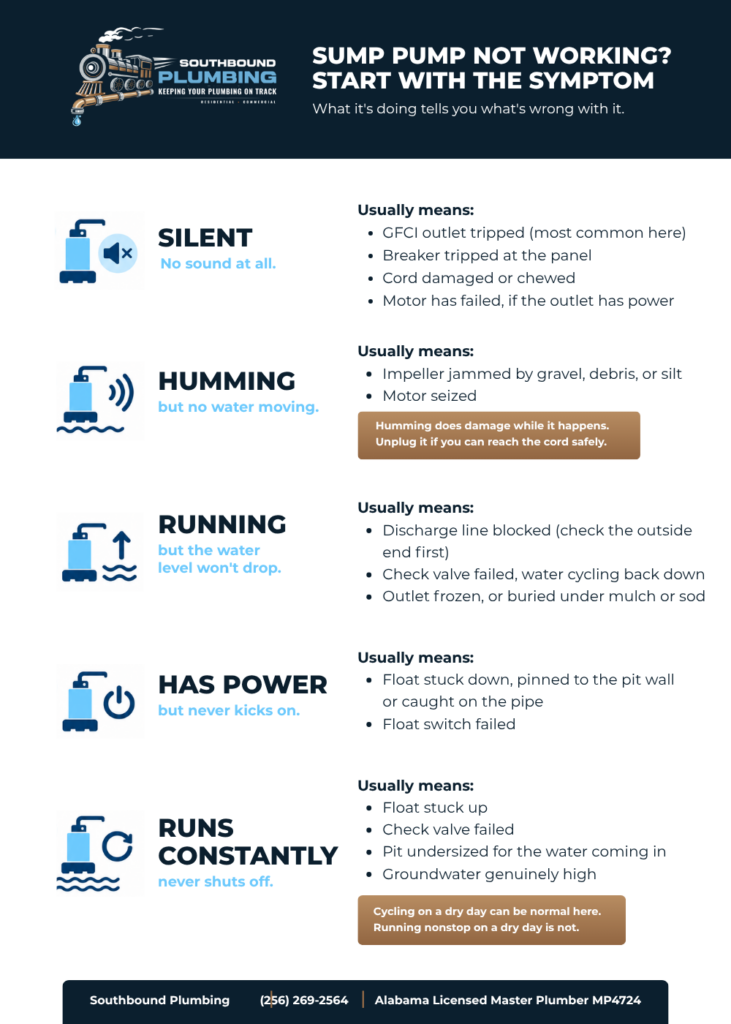
The Pump Will Not Turn On at All
Total silence almost always means the pump isn’t getting power, and around here the most common reason by far is a tripped GFCI outlet.
What makes that one so sneaky is how quietly it happens. A GFCI can trip for any number of reasons, some of them fairly minor, and when the pump is tucked into a crawl space or a back corner of the garage there’s nothing to tell you about it. No noise, no warning light, no alert on your phone. The pump simply stops existing as far as the rest of the house is concerned, and it stays that way until the next hard rain finds it out.
Beyond the GFCI, a pump can stay dead because a breaker tripped at the panel, because the cord has been damaged or chewed on by something living under the house, or because the motor has finally reached the end of its life. If the outlet has power and the pump still does absolutely nothing, the motor is usually your answer.
One thing worth understanding about that outlet: a GFCI that trips once might genuinely be nothing, but a GFCI that trips again after you reset it is telling you there’s a real fault somewhere, often moisture getting into a place it has no business being, and that isn’t something to keep resetting and hoping about.
The Pump Hums But Does Not Pump
Humming tells you the motor is getting power and actively trying to run, but something is physically preventing it from turning.
Most of the time the culprit is the impeller, which is the small spinning part that actually moves the water through the pump. Gravel, a chunk of debris, or silt that has gradually built up in the bottom of the pit works its way in there and jams it solid. Occasionally it’s the motor itself that has seized after enough years of service, and that’s a different conversation.
Either way, that humming is doing damage the entire time it continues, because a motor straining against something it cannot turn heats up in a hurry. If yours is humming right now, unplug it if you can reach the cord safely without getting into the water, and then leave it alone until somebody can look at it properly. A jammed impeller caught early is often a straightforward fix, while a motor that hummed away for three days usually isn’t.
The Pump Runs But Water Is Not Going Anywhere
The motor sounds healthy, the pump is clearly running, and yet the water level in the pit refuses to budge. That’s a discharge problem, and it comes down to one of three things nearly every time.
The discharge line might simply be blocked somewhere between the pump and the outside, and the outside end is worth checking first because that’s usually where the obstruction lives and it’s the only part you can actually see. The check valve might have failed, which matters more than it sounds like it should: a check valve is a one-way gate on the discharge line that keeps water from running back down into the pit after the pump shuts off, so when it fails the same water just cycles up and back forever and the pit never empties. Or the line has frozen at the outlet in January, or grown over with mulch and sod and leaf pack during the rest of the year.
That last one is the easiest problem on this entire list to prevent. Walk out and look at where that pipe ends a couple of times a year, and you’ll catch it long before it becomes a flooded crawl space.
The Float Switch: The Single Most Common Failure Point
The float switch is the part that tells the pump when to turn on, and it works about as simply as it sounds. A float rides up with the rising water, and at a certain height it closes a switch that starts the motor. That simplicity is exactly why it’s also the part that fails most often, and it fails in three recognizable ways.
It can get stuck down, which is the classic version. The float ends up pinned against the wall of the pit, wedged in behind the pump, or hung up on the discharge pipe, so the water rises but the float never rides up with it and the motor never gets its signal. That’s how a pump in otherwise perfect working order sits there and lets a crawl space flood. It can also get stuck up, unable to drop back down, which leaves the pump running and running with nothing left to move. And sometimes the switch itself simply fails, so the float moves exactly the way it should and nothing registers on the other end.
You can often spot a stuck float from outside the pit, which is why it made the checklist. What you shouldn’t do is reach in and free it with the pump still plugged in. It’s also worth knowing that a pit that’s undersized, or a pump that got set slightly off-center when it was installed, will keep hanging that float up no matter how many times somebody frees it, and in those cases the real fix is repositioning the pump rather than replacing the switch.
The Pump Runs Constantly and Will Not Shut Off
This symptom worries people less than it probably should, because at least the thing is running. But a pump that never gets a rest is wearing out on fast-forward, and it will eventually fail at the least convenient moment available to it.
The usual causes are a float stuck in the up position, a failed check valve quietly sending the same water back down for the pump to move all over again, a pit that’s undersized for how much water is genuinely coming in, or a water table that’s simply high right now.
That last cause deserves a note specific to this area, because our red clay holds water for a long time. After a good soaking rain, the ground around a lot of homes here stays saturated for days afterward, and a pump can legitimately cycle on and off well after the sky has cleared. Running periodically on a dry day isn’t necessarily a fault at all, though running continuously on a dry day is a different matter and worth a call.
Crawl Space Sump Pumps in North Alabama Homes
Almost everything written about sump pumps assumes you have a basement, and most homes around here simply don’t have one.
In this part of Alabama, sump pumps tend to sit in crawl spaces and garages instead, and that changes how a failure announces itself. With a basement you tend to notice, because you go down there for one reason or another, you see standing water, and you deal with it. A crawl space pump can fail in March and go completely unnoticed until July, for the simple reason that nobody has any particular reason to open that hatch in between.
So the symptoms reach you sideways instead of directly:
- A musty or earthy smell that’s strongest near a floor vent or a closet on an exterior wall
- Floors that feel soft or springy in one part of the house but not another
- Indoor humidity that stays stubbornly high no matter what the air conditioning does
- Insulation hanging down under the floor, or visibly wet on the rare occasion you do look
- Mold or mildew showing up on baseboards or in a closet with no obvious source
None of that reads as a plumbing problem to a homeowner, which is exactly why crawl space pumps get discovered so late in the game. If you have one, the single most useful thing you can do is put a reminder on your phone twice a year to open the hatch and take a look, because that two-minute habit beats finding out about it in July.
While we’re here, it’s worth clearing up what a sump pump is and isn’t, because these two units get mixed up constantly. A sump pump moves groundwater and nothing else, so it has no connection to your toilets, sinks, or showers. The unit that handles waste water from fixtures sitting below the main sewer line is a sewage ejector pump, which is a different piece of equipment doing an entirely different job.
When the Pump Needs Replacement Instead of Repair
Some of these failures are well worth fixing and some of them really aren’t, and I’d rather tell you which is which than sell you the wrong one.
A jammed impeller, a stuck or failed float switch, a bad check valve, or a blocked discharge line are all worth repairing. Those are ordinary parts and ordinary fixes on a pump that still has plenty of life left in it, and there’s no sense replacing a whole unit over any of them.
A seized motor is a different story, as is a pump that sat there humming for days before anybody caught it, and so is any pump that has been running long enough to be near the end of its service life anyway. Most sump pumps last somewhere in the range of seven to ten years, and one that cycles constantly because of high groundwater tends to get there a good deal sooner.
There’s also a sizing question that comes up more often than you might expect. If the pit itself is undersized, or the pump was undersized for how much water your particular lot produces, then replacing it with the same unit just buys you the identical problem again in a few years. Sometimes the honest answer is a different pump, or the same pump positioned better, rather than another round of exactly what failed.
We install and repair sump pumps, check valves, and effluent pumps as part of our plumbing repair and installation work across Huntsville, in crawl spaces and garages just as often as basements. A licensed Alabama master plumber performs or directly supervises the work, and you’ll have a flat-rate quote in writing before anything gets started, with a free estimate either way. One thing I want to be clear about up front: pump work in a flooded space doesn’t include pumping the water out, though we’ll coordinate with a restoration company when that turns out to be the right call.
If water is actively rising and the pump is dead, don’t wait on business hours to deal with it. Our emergency plumbing service answers around the clock, and homeowners in Owens Cross Roads typically get a two-hour window because we’re based right here on this side of the mountain.
Ready When You Are
If your sump pump is humming, silent, or running nonstop, give us a call before the next storm makes the decision for you. A licensed Alabama master plumber will work out what actually failed, tell you straight whether it’s worth repairing, and put the price in writing before any work starts.
Call (256) 269-2564 or request a free estimate online.
Same-day service, seven days a week.
Frequently Asked Questions
Why is my sump pump humming but not pumping?
Humming means the motor is getting power but something won’t let it turn, and most of the time that something is the impeller, the small spinning part that moves the water, jammed up by gravel or debris or silt from the bottom of the pit. Occasionally it’s a seized motor instead. Either way the humming is doing damage the whole time it continues, so unplug the pump if you can reach the cord safely without getting into the water, then leave it until somebody can look at it.
How long does a sump pump last?
Most of them last somewhere in the range of seven to ten years. A pump that cycles constantly, whether because the pit is undersized or the groundwater is high, wears out noticeably faster than one that only runs a few times after a storm. If yours is already in that range and giving you trouble, its age is worth weighing in the repair-or-replace decision rather than fixing it and hoping.
Can I shower if my sump pump is not working?
If what you have is a sump pump, then yes. A sump pump moves groundwater and has nothing at all to do with your household drains, so showering and flushing send nothing to it. If the unit that failed is actually a sewage ejector pump, which handles waste from fixtures below the main sewer line, then no, and you’ll want to stop using those fixtures until it’s fixed because that water has nowhere to go. People mix the two up all the time, so it’s genuinely worth knowing which one is under your house.
Should my sump pump run when it is not raining?
Sometimes, and that by itself is normal. Groundwater doesn’t track rainfall exactly, and our red clay holds water for days after a long soaking rain, so a pump cycling on and off during a dry stretch isn’t automatically a problem. Running continuously on a dry day is a different matter, and that usually points to a float stuck up, a failed check valve sending the same water back down, or a pit that’s undersized for how much water your lot actually produces.
Who do I call when a sump pump fails?
A licensed plumber. Sump pump work involves both plumbing and electrical connections, and the discharge side has to be run correctly or you’ll be dealing with the same thing again before long. We’re a locally owned plumbing company based in Hampton Cove, and every job is performed or directly supervised by Alabama master plumber MP4724.
Do you install sump pumps in crawl spaces?
Yes, and around here that’s where most of them end up going. Crawl space installs come with their own considerations: getting the pit placed and sized correctly, keeping the float clear of the walls, running the discharge so it exits well away from the foundation, and handling the electrical properly in a damp space. We install new pumps with check valves and repair existing ones in crawl spaces, garages, and basements alike.