Service your grease trap before the combined grease and solids reach about a quarter of its total depth. That is the benchmark most of this industry works from, and for a busy kitchen it usually lands somewhere between monthly and quarterly, though a small under-sink trap on a fryer-heavy menu can hit that mark in a couple of weeks. Your actual required interval is set by your local authority and your permit rather than by any general rule, so check what applies to your location. What follows is what the interval is really measuring, and what it costs you when the schedule slips.
How Often Should a Grease Trap Be Cleaned?
The honest answer is that nobody can give you a number from a distance, because the interval depends on your menu, your volume, and the size of the trap you inherited with the space. A trap sized correctly for a sandwich shop and a trap sized correctly for a fry station are different pieces of equipment doing different amounts of work.
What you can do is measure rather than guess. Check the trap yourself once a month, note how deep the grease and solids layers have gotten, and you will know your own interval within two or three months. Kitchens that do this stop having surprise backups, because they are servicing on a schedule the trap actually earned rather than one somebody guessed at when the place opened.
The one thing worth saying plainly: requirements vary by municipality, and some jurisdictions set a maximum interval regardless of how clean your trap looks. Find out what yours requires before you build a schedule around the 25 percent rule alone.
How a Grease Trap Actually Works
A grease trap slows your wastewater down long enough for physics to sort it out. Fat floats to the top, solids settle to the bottom, and the relatively clear water in the middle passes on to the sewer. Baffles inside the trap hold that floating layer back so it does not simply wash out with the next surge from the dish pit.
Everything about maintenance follows from that. The trap only works while there is a middle layer for water to pass through, so as the grease layer thickens from the top and the solids build from the bottom, the working space between them shrinks. Separation gets worse gradually rather than all at once, which is exactly why the failure sneaks up on people.
The 25 Percent Rule and Why It Sets Your Schedule
The 25 percent rule says that once grease and solids together fill about a quarter of the trap’s depth, it needs servicing. It sounds arbitrary until you understand what it is protecting.
Below that point, there is enough clear space in the middle for water to slow down and separate the way the trap was designed to. Above it, water starts moving through faster and closer to the grease layer, so less separation happens on every gallon. Push it further and the trap stops being a trap at all: grease passes straight through and heads out into your sewer line, which is the expensive version of this problem.
So the rule is not about the trap being dirty. It is about the trap still having room to do its job.
What Happens When You Skip Grease Trap Service
Neglect does not produce one dramatic failure. It produces a sequence, and each stage costs more than the one before it.
First the odor shows up, usually in the kitchen and sometimes out in the dining room, because the trapped organic layer is breaking down and there is more of it than there should be. Then separation degrades and grease begins passing into your sewer line, where it cools on the pipe wall and starts closing the line from the inside. Next your drains slow down, the three compartment sink takes longer to clear, and a floor drain starts backing up during service. Eventually the line closes far enough that waste comes back up into the kitchen, and that is the night you are not serving anybody.
The part operators tend to underestimate is that the sewer line damage outlasts the trap problem. Pumping the trap out at that point stops it getting worse, but the grease already sitting in your line is still there, and clearing that is separate work.
Why Grease Traps Smell and How to Stop It
The smell is the trapped organic material breaking down, and it gets worse the longer that material sits. It is the earliest warning you get, and it is worth treating as information rather than as an annoyance to cover up.
Four things drive it. The service interval has stretched too long, which is the usual answer. Solids are building faster than expected because too much food debris is reaching the trap instead of being scraped off first. The trap’s vent is not drawing properly, so gas that should be leaving comes back into the room. Or the trap lid gasket has failed and no longer seals.
What actually stops it is servicing on schedule and keeping solids out in the first place. What does not stop it is pouring enzyme or bacteria products in. Those additives break grease down into smaller particles, which sounds helpful and is the opposite of what you want, because a trap works by keeping grease in one piece long enough to float. Emulsified grease passes straight through the trap and ends up in your line. Some jurisdictions prohibit them outright for exactly that reason.
Undersized Traps: When the Schedule Is Not the Problem
Sometimes a kitchen does everything right and still has trouble, and the trap itself is the reason.
If you took over a space that used to be something else, the trap was sized for that operation rather than yours. A coffee shop converted to a full kitchen is the classic version. You can also outgrow a trap that was correct when you opened, because volume went up or the menu changed toward fried food. And a dishwasher discharging hot water directly into a small trap will push flow through faster than it can separate, no matter how recently it was serviced.
The tell is a trap that hits the 25 percent mark far sooner than the interval you were told to expect, or a trap that gets serviced on time and still lets grease into the line. That is a sizing conversation, not a scheduling one, and it is worth having before you keep paying for service that cannot fix it.
Grease Trap Records and Health Inspections
Many jurisdictions running a fats, oils, and grease program require you to keep documentation of every service, usually a manifest from whoever did the work showing the date, the volume removed, and where it went. Check whether yours does, because if it does, missing paperwork can be a finding even when the trap itself is spotless.
Keep it simple and keep it where somebody can find it. A binder or a folder with every service manifest, plus your own monthly depth checks with dates, is enough. The monthly log is not usually required, but it is the thing that lets you demonstrate you are managing the trap deliberately rather than reacting to problems.
What an inspector requires is between you and your local health authority, and it varies. What we can do is document the plumbing work we perform in writing, so you have a record of it for whatever conversation comes next.
Trap, Interceptor, or Both?
People use the two words interchangeably and they are not quite the same thing. The distinction matters mostly because it changes who services it and how often.
| Grease trap | Grease interceptor | |
| Where it sits | Under the sink or nearby, inside | Buried outside, usually in the lot |
| Size | Small, rated in gallons per minute | Large, often hundreds of gallons |
| Serves | One or two fixtures | The whole kitchen |
| Service interval | More often, sometimes monthly | Less often, but a bigger job |
| Who services it | Often in-house or a hauler | Licensed waste hauler with a vacuum truck |
Some operations have both, with small traps at specific fixtures and an interceptor outside catching everything. If that is your setup, they are on separate schedules, and the outdoor interceptor is the one that tends to get forgotten because nobody walks past it.
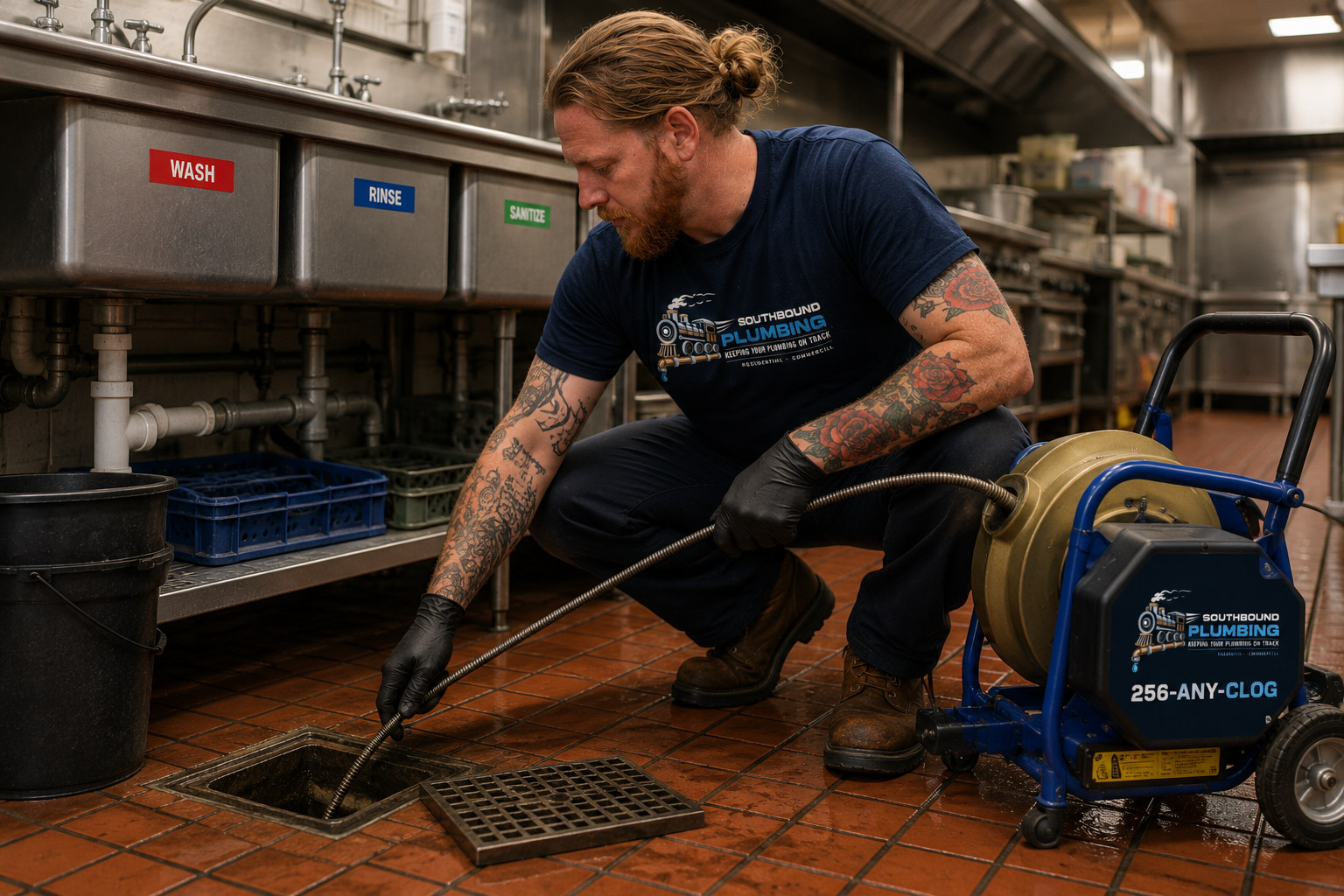
Here is where we fit. We clear and maintain the drain lines running to and from your trap or interceptor, which is where restrictions actually show up and where a neglected trap does its lasting damage. Pumping the trap out is separate work handled by a licensed waste hauler with a vacuum truck. If your lines are slowing down, backing up, or you are seeing the early signs above, that is our commercial drain cleaning and sewer service.
For the wider picture on what else fails in a commercial kitchen, from three compartment sink lines to flushometers to water heater recovery, see our guide to what breaks most in a commercial kitchen. We handle all of it through our commercial plumbing service for Huntsville businesses, scheduled around your service hours rather than ours, with a flat-rate quote in writing before work begins and no franchise markup on top. That includes operators in the MidCity District and across Huntsville and Madison County.
Before It Costs You a Night
If your drains are slowing down, a floor drain has started backing up, or the smell has moved out into the dining room, those are the early parts of the sequence rather than isolated annoyances. A licensed Alabama master plumber will look at your lines, tell you plainly what is happening, and quote the work in writing before starting.
Call (256) 269-2564 or request a free estimate online.
Commercial work scheduled around your service hours.
Frequently Asked Questions
How often should a grease trap be cleaned?
Before grease and solids together reach about a quarter of the trap’s depth, which for most kitchens works out somewhere between monthly and quarterly. A small under-sink trap serving a fryer-heavy menu can get there in a couple of weeks. The reliable way to find your own interval is to check the depth monthly for two or three months and let the trap tell you. Your local authority may also set a maximum interval regardless, so confirm what applies to your permit.
Why does my grease trap smell?
The trapped organic layer is breaking down, and the smell means there is more of it in there than there should be. Usually the service interval has stretched too long. It can also mean solids are building faster than expected because food debris is not being scraped off before washing, that the trap’s vent is not drawing properly, or that the lid gasket has failed and no longer seals. Servicing on schedule and keeping solids out is what actually fixes it.
What is the 25 percent rule?
It is the benchmark that says a grease trap needs servicing once grease and solids together fill about a quarter of its total depth. The point is not cleanliness, it is working room: below that mark there is enough clear space in the middle for water to slow down and separate properly, and above it separation degrades and grease starts passing through to your sewer line.
Do I need to keep grease trap service records?
Very likely, though it depends on your jurisdiction. Many places running a fats, oils, and grease program require a manifest for every service showing the date, the volume removed, and the disposal destination. Check what yours requires, because missing paperwork can be a finding even when the trap is in good shape. Keeping your own monthly depth checks alongside the manifests is not usually required but it is worth doing.
What is the difference between a grease trap and an interceptor?
Size and location, mainly. A grease trap is the smaller unit, sitting under or near a sink inside and serving one or two fixtures. An interceptor is the large version, usually buried outside and sized for the whole kitchen. Traps need service more often but each service is a smaller job, while interceptors go longer between services and take a vacuum truck when they need one. Some kitchens have both, on separate schedules.
What happens if a grease trap overflows?
You get wastewater and grease on the kitchen floor, which is a sanitation problem and a slip hazard at the same time, and it generally means the trap was well past due or something downstream of it is blocked. Stop running water into the fixtures feeding it, get the floor contained, and call. The overflow itself is the visible part, but by the time a trap overflows there is usually grease sitting in your sewer line that needs dealing with separately.