Restaurant plumbing fails in a handful of predictable places, and it’s the same five over and over: three compartment sink drain lines, floor drains loaded with grease, the grease trap itself, flushometers in the customer restrooms, and a water heater that can’t keep up with the dish pit. Nearly all of it comes down to grease, volume, or both. Here’s what actually breaks in a commercial kitchen, why it breaks, and what your maintenance schedule ought to cover.
You already know how this goes. It’s 6:15 on a Friday, the dish pit is stacked, and the floor drain by the fryer station starts pushing water back. Nobody has time to deal with it, so somebody throws a mat over it and the line keeps moving. By 9:00 it’s across the kitchen floor and you’re making a decision about tomorrow’s service.
The Five Plumbing Failures That Close a Kitchen
Residential plumbing fails from age. Your plumbing fails from load. Your lines see more water, hotter water, and far more fat, oil, and grease in a week than a house sees in a year. That changes what breaks and how fast.
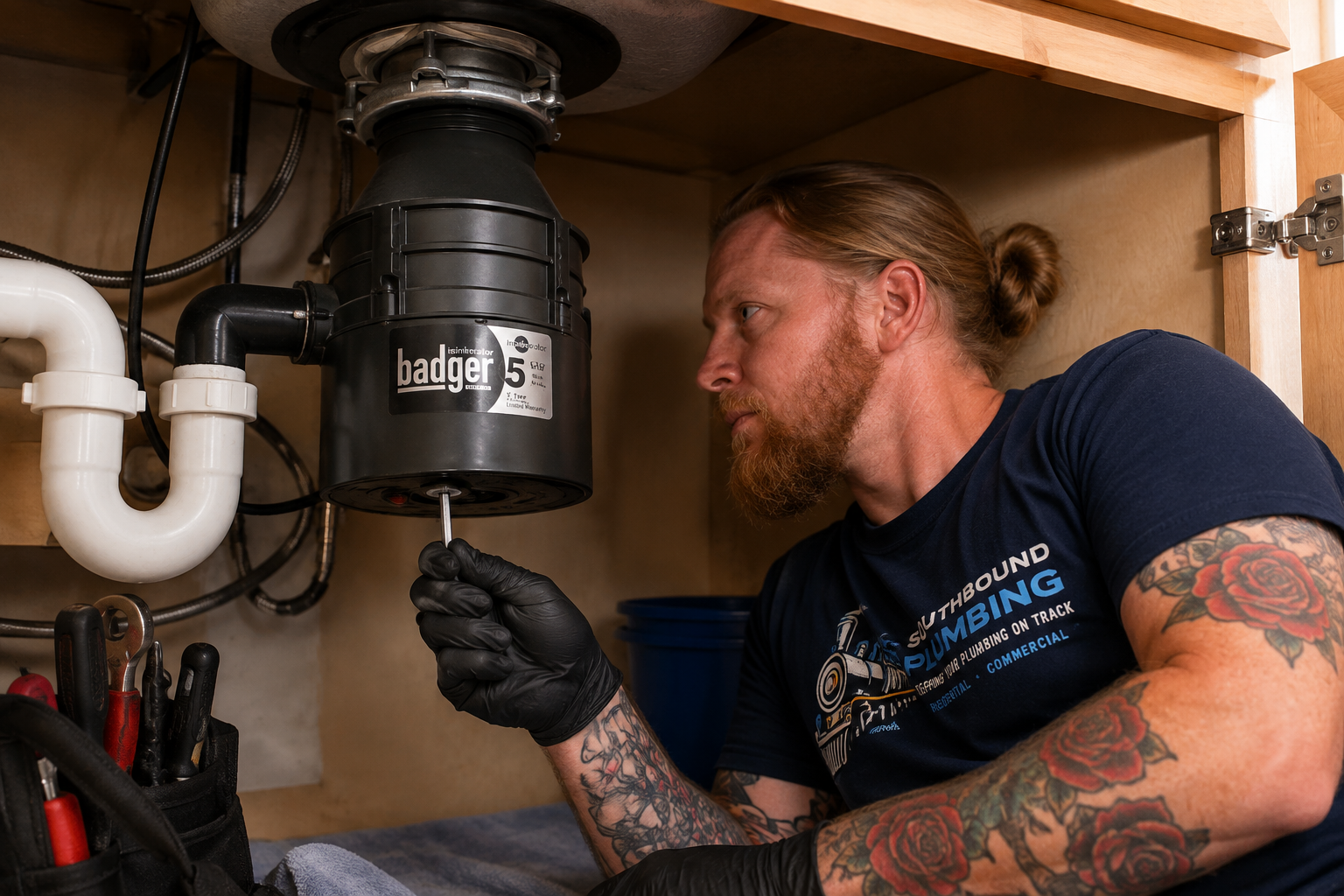
Three compartment sink drain lines. The highest-volume drain in the building, and the one taking the most grease directly.
Floor drains. They catch everything that hits the floor, including grease that’s already cooled off.
The grease trap. When it stops working, everything upstream of it stops working too.
Flushometers. The valves on your commercial toilets and urinals. They fail quietly until one runs all night or won’t flush at all.
Water heater capacity. Not a failure exactly, but a mismatch that shows up as a sanitation problem.
Each one gets its own section below.
Three Compartment Sink Drain Lines
Your three compartment sink is the busiest drain in the building. Wash, rinse, sanitize, all day, every bit of it running warm water carrying dissolved fat.
Here’s the part that catches people. Grease goes down that line as a liquid. Twenty feet later, after it’s given up its heat to the pipe, it isn’t a liquid anymore. It coats the inside of the line in layers, the same way plaque builds in an artery. The drain works fine, then it works a little slower, then one night it doesn’t work at all. Nothing changed that day. That line had been closing for months.
Two things make it worse in a lot of Huntsville kitchens. Older buildings downtown and along the older commercial corridors often still have cast iron waste lines, and cast iron gets rough inside as it ages, which gives grease more to grab onto. And a line run with too little fall, meaning not enough downhill slope, lets water sit instead of carrying solids along with it.
What helps: scrape plates and pans before they hit the sink, never pour cooking oil down any drain, and get that line cabled on a schedule instead of waiting for it to close on you. Cleaning it mechanically with a cable machine cuts the buildup back off the pipe wall and gets you your full diameter again.
Floor Drains and Grease Loading
A clogged floor drain is the one that puts water on your kitchen floor, and that makes it a sanitation problem and a slip problem at the same time.
Floor drains take a different kind of abuse than sink lines. Whatever reaches them has usually cooled off already, so it shows up as semi-solid grease instead of liquid. Add mop water, food debris, broken glass, and whatever gets swept toward them, and the trap under the drain fills from the bottom up.
Watch for these before it turns into an emergency:
- Water standing around the drain after a mop-down instead of clearing in a minute or two
- A gurgle from a nearby drain when the three compartment sink empties
- Sewer odor near the drain, especially in a corner of the kitchen that doesn’t get used every day
- The drain that backs up first is always the same one, and it’s always the lowest one in the room
That last one matters more than it looks. The lowest drain in your building is your pressure relief valve, whether you meant it to be or not. When something downstream is restricted, that’s where it shows up first. So a floor drain that keeps backing up usually isn’t telling you about itself. It’s telling you about the line beyond it.
The Grease Trap and What a Failing One Does to Your Lines
Your grease trap is the last thing standing between the kitchen and the sewer line, and when it stops separating properly, everything downstream of it starts paying for that. Grease that should be sitting in the trap moves out into your sewer line instead, where it cools on the pipe wall and begins closing the line the same way it closes a sink drain. That is usually the sequence behind an outside line that backs up with no obvious cause in the kitchen.
The trap can fail because it is simply full, because a baffle inside has corroded or broken loose, or because the volume moving through it is more than it was sized for. All three look about the same from the outside, which is the frustrating part, and all three end the same way in your lines.
We clear the drain lines running to and from the trap, which is where the restrictions actually show up. Pumping the trap itself out is separate work handled by a licensed waste hauler. For the full picture on service intervals, the 25 percent rule, odor, and what a neglected trap costs, see our guide to grease trap maintenance and how often to clean one.
Flushometers in Customer Restrooms
A flushometer is that exposed metal valve on a commercial toilet or urinal, the kind with a handle on the side and no tank. Instead of storing water, it releases a measured burst straight from the supply line. That’s why your fixtures flush harder than the ones at home and can cycle back to back through a rush.
Inside is a rubber diaphragm doing the actual work, and diaphragms wear out. When one goes, you get one of two failures: the fixture runs continuously, quietly running up your water bill all night, or it won’t flush at all, which means an out-of-order sign in a customer restroom on a Saturday.
Neither one closes your kitchen. Both affect what a customer thinks of your operation. We rebuild flushometers, replace them, and handle the stops and spuds that go with them.
Water Heater Capacity and Recovery in a Commercial Kitchen
This one shows up as a sanitation problem instead of a plumbing problem, which is exactly why it gets missed.
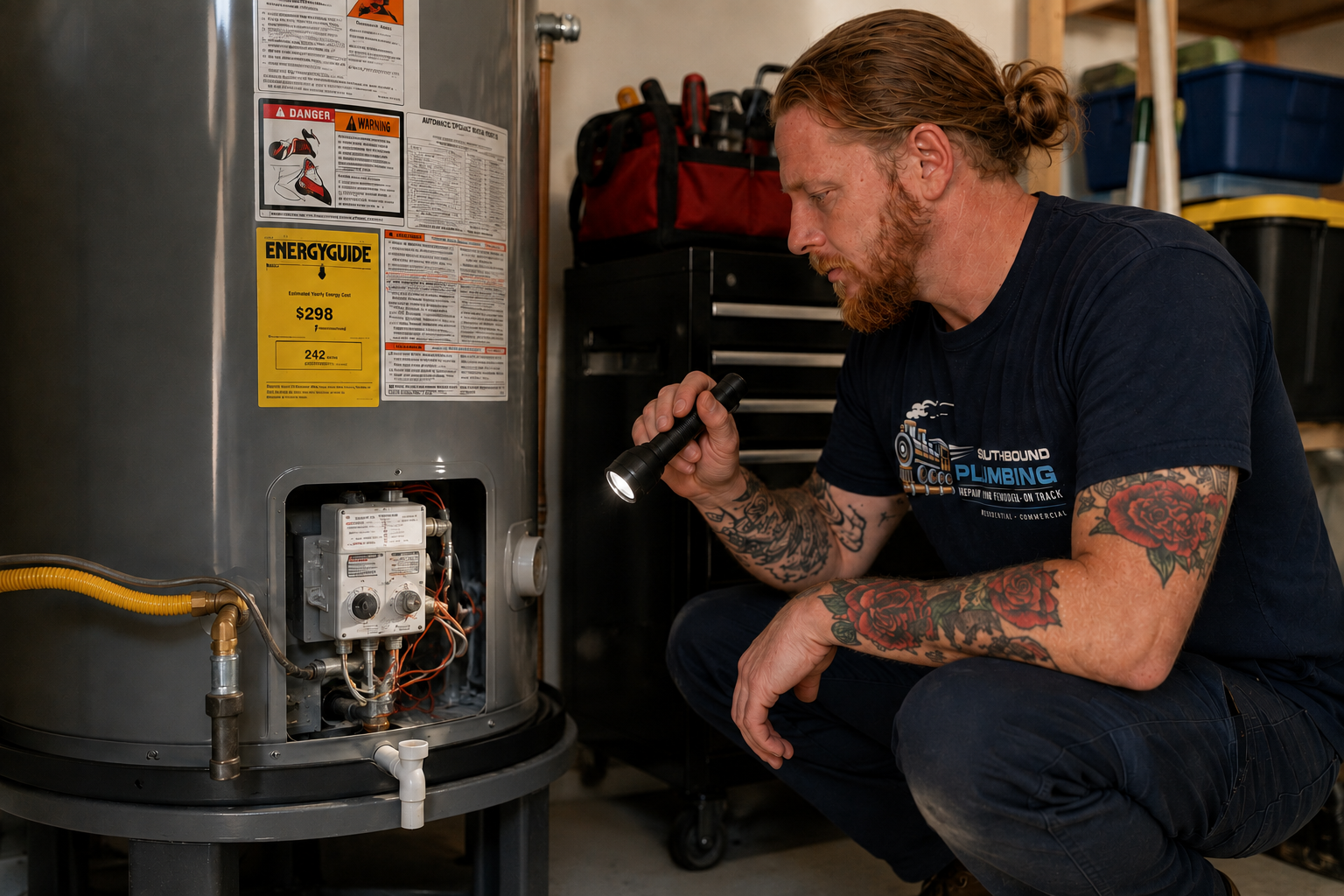
If your dish pit runs out of hot water mid-service, or the three compartment sink can’t hold sanitizing temperature through a rush, the issue usually isn’t a broken heater. It’s recovery rate, meaning how fast the unit can reheat a tank after you’ve drawn it down. A heater sized for the kitchen you had four years ago doesn’t necessarily fit the kitchen you’re running now.
Signs you’ve outgrown it: hot water’s fine at open and gone by the middle of the dinner rush, the dish machine cycles longer trying to reach temperature, or somebody quietly turns the thermostat up to compensate, which creates a scald risk out front.
Our hard water is a factor too. Scale builds up inside the tank and insulates the water from the heat source, so a unit that’s never been flushed recovers slower every year it runs.
What a Restaurant Plumbing Maintenance Schedule Should Cover
Maintenance is cheaper than emergency service, and the real difference is that you get to choose when it happens.
| Interval | What gets done |
| Daily | Scrape and dry-wipe pans before washing. Never pour oil down a drain. Flush floor drains with hot water at close. |
| Weekly | Pull and clean floor drain strainers. Check for standing water around drains after mop-down. |
| Monthly | Look at the grease trap level. Check flushometers for running or weak flush. Check under the three compartment sink for drips at the trap and tailpiece. |
| Quarterly | Cable the three compartment sink line and the main kitchen drain before they restrict. Check water heater temperature and recovery through a peak service. |
| Annually | Full drain line inspection. Water heater flush. Check the trap’s condition and its baffles. Make sure your shutoff valves actually close. |
| Per your permit | Grease trap or interceptor pump-out at the interval your local authority requires. |
The quarterly line cleaning is the one that pays for itself. A line cleared on a Tuesday morning costs you nothing in service. That same line cleared on a Friday night costs you the night.
What It Costs to Be Closed for a Day
You don’t need a number from me here, because you already know your own. You know what a Saturday does. You know what your labor costs whether you serve anybody or not, what happens to product you prepped for a service that didn’t happen, and how long it takes a regular who showed up to a locked door to come back.
That’s the real math on restaurant plumbing. The repair itself is rarely the expensive part. The closure is.
It’s also why we schedule commercial drain work around your hours instead of ours. Early morning before prep, late night after close, whatever keeps your doors open.
We handle commercial plumbing for Huntsville businesses, including commercial drain cleaning and sewer work, flushometer repair and replacement, and water heater service. A licensed Alabama master plumber performs or directly supervises every job, you get a flat-rate quote in writing before work starts, and there’s no franchise markup sitting on top of it.
We’re based in Hampton Cove, east of the mountain, which puts us close to the restaurant and retail corridors on this side of Huntsville. That includes operators in the MidCity District and the office and restaurant tenants around Research Park.
Ready When You Are
If a drain’s slowing down, a floor drain is backing up, or your dish pit is running out of hot water mid-service, call before it turns into a closed night. A licensed Alabama master plumber will diagnose it, quote it in writing, and schedule the work around your hours.
Call (256) 269-2564 or request a free estimate online.
Same-day service, seven days a week.
Frequently Asked Questions
How often should a restaurant have its drains cleaned?
For most kitchens, cabling the three compartment sink line and the main kitchen drain quarterly keeps you ahead of grease buildup. High-volume kitchens, especially fry-heavy menus, usually need it more often. The honest way to set your interval is to start quarterly and watch what comes out. If that line’s already restricting at three months, tighten it up.
How is a three compartment sink supposed to be plumbed?
Each compartment drains into its own trap, and the three tie into a shared waste line that runs to the grease trap. The detail that matters most is the indirect connection, meaning the line discharges through an air gap rather than being hard-piped straight into the drain, which keeps waste from backing up into a sink you sanitize dishes in. If yours was piped by whoever had the space before you, it’s worth having somebody confirm it was done right, because it’s a common thing to find wrong.
Why does my commercial floor drain keep backing up?
If the same floor drain backs up over and over, it usually isn’t about that drain. The lowest drain in a building is where a restriction downstream shows itself first. So a floor drain that keeps backing up is generally reporting a problem in the line beyond it, often grease buildup between your kitchen and the trap, or between the trap and the main.
What is the difference between commercial and residential drain cleaning?
Load, access, and timing. Your kitchen line carries far more grease and volume than a house does, so it needs larger equipment and more frequent service. Access is different too, since commercial buildings have cleanouts, floor drains, and grease traps a house doesn’t. And the work has to fit around your service hours, because a residential drain can wait until tomorrow and yours generally can’t.
Who is responsible for plumbing in a leased restaurant space?
It comes down to your lease, and they vary quite a bit. Commonly the landlord owns the building’s main lines and structure while the tenant owns fixtures, equipment, and the lines serving their own space, but plenty of leases split it differently, especially on the grease trap. Read yours before you have a problem, and get an attorney to look at it if the language isn’t clear. We’ll document what we find either way, so you’ve got something to bring to that conversation.
Do you work outside business hours so we do not have to close?
Yes. We schedule commercial drain work around your service, early mornings before prep or late nights after close, and we answer around the clock for emergencies. Keeping your doors open is usually the whole point of the call.
Do you handle health inspection related plumbing issues?
We handle the plumbing work: drain lines, floor drains, backed-up fixtures, water heater temperature and recovery, and flushometer repairs. We’ll tell you plainly what we find and put the repair in writing. What your inspector requires is between you and your local health authority, so bring us the specific items and we’ll take care of the plumbing side of them.