The sound your garbage disposal makes tells you almost everything you need to know about what’s wrong with it. A disposal that hums without spinning is jammed, and you can usually free it yourself in about five minutes. A disposal that’s completely silent has lost power somewhere, whether at the reset button, the switch, or the breaker. And a disposal that’s leaking from the bottom is telling you the unit itself is finished, which is a replacement rather than a repair. Here’s how to work through all three.
Before anything else, one rule that has no exceptions. Never put your hand down into the disposal, not even with the switch off and not even for a second. Everything in this article is done from outside the unit or with a tool, and if something needs to come out of the grinding chamber it comes out with tongs or a pair of pliers. Turn the switch off before you start, and if you want an extra margin of safety, go flip the breaker for the kitchen too.
Most of these calls come in on a Sunday afternoon, usually right after somebody put something down there that shouldn’t have gone down there. It’s a common enough problem that it’s worth knowing how to handle the easy version yourself, because a jammed disposal is genuinely one of the few plumbing problems a homeowner can fix without a truck showing up.
What the Sound Tells You: Humming, Silent, or Grinding
Start here, because the sound narrows it down immediately and saves you from checking things that were never the problem.
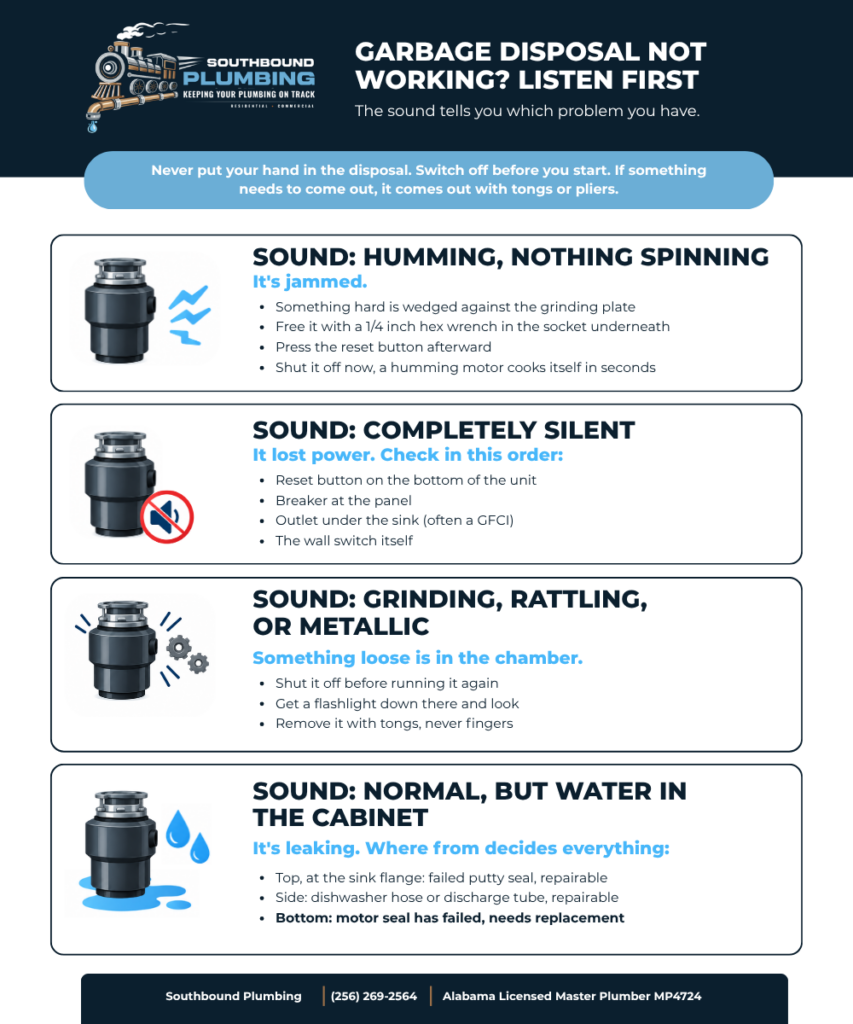
If it hums but nothing spins, the motor is getting power and trying to turn while something inside physically blocks it. That’s a jam, and the fix is the hex wrench procedure below. If it’s completely silent when you flip the switch, the motor isn’t getting power at all, which sends you to the reset button first and then to the breaker and the switch. If it’s grinding loudly, rattling, or making a metallic racket, something hard is loose in the chamber, so shut it off and get a light down there before you run it again. And if water is collecting in the cabinet underneath, you have a leak rather than a mechanical problem, and where it’s leaking from decides whether it’s fixable.
Garbage Disposal Humming But Not Spinning
This is the most common disposal failure there is, and the good news is that it’s usually the least serious one.
Inside the disposal there’s a spinning plate with two blunt impellers on it, which is what actually does the grinding. When something wedges between that plate and the wall of the chamber, the motor keeps trying to turn it and can’t, so you get that low hum instead of the usual grinding sound. Fruit pits, small bones, a bottle cap that fell in, a piece of silverware that went down with the dishes, or a wad of fibrous vegetable peel are all common culprits.
The thing to understand is that the hum is doing damage the entire time you let it continue. That motor is drawing full current with nowhere for the energy to go, so it heats up quickly, and a disposal left humming for even thirty seconds at a stretch can cook itself. Turn the switch off as soon as you hear it, and don’t keep flipping it on to see whether it works this time. It won’t, and each attempt costs you motor life.
How to Use the Allen Wrench to Free a Jammed Disposal
Nearly every disposal on the market has a hex socket built into the center of its underside, specifically so you can turn the plate by hand and break a jam loose. Most units take a 1/4 inch hex wrench, and the manufacturer usually ships one clipped to the side of the unit or taped underneath it. If yours has gone missing, a standard 1/4 inch allen wrench from any hardware store does the same job.
- Turn the disposal switch off. If you want to be certain, flip the breaker for the kitchen circuit as well.
- Find the hex socket. It’s dead center on the bottom of the unit, and you’ll need to get under the sink with a flashlight to see it.
- Insert the wrench and work it back and forth. Turn it both directions, and expect some resistance at first. You’re trying to rock whatever is wedged in there loose rather than force the plate in one direction.
- Keep going until it turns a full rotation freely. When the wrench spins all the way around with no catch, the jam has broken loose.
- Look inside with a flashlight and remove whatever caused it. Use tongs or needle-nose pliers, never your fingers, and get the object out rather than trying to grind it.
- Press the reset button on the bottom of the unit. A jam almost always trips it, so this step gets skipped a lot and then people think the wrench didn’t work.
- Restore power, run cold water, then flip the switch. Let the water run for a few seconds before and after so anything loosened up clears the line.
If the wrench turns freely and the unit still only hums after you’ve reset it, the motor is likely finished. That happens most often on disposals that ran jammed for a while before anybody noticed.
Where the Garbage Disposal Reset Button Is and How to Use It
The reset button is a small red or black button on the bottom of the disposal, usually near the center and close to the hex socket. It’s a thermal overload protector, which means it trips and cuts power whenever the motor draws more current than it should, and it exists specifically to keep a jam from burning the motor out.
Using it is about as simple as it gets: reach under the sink with a flashlight, find the button, and press it firmly until it clicks and stays in. If it’s already flush with the housing, it hasn’t tripped and your problem is somewhere else. If it pops right back out when you let go, the unit is still too hot, so give it ten or fifteen minutes to cool down and try again.
What matters more than the procedure is what a trip actually means. A button that trips once after an obvious jam is doing exactly its job, and once you’ve cleared the jam it should hold fine. A button that trips again a day or two later, or one that won’t hold a reset at all, is telling you the motor is drawing too much current for a reason nobody has found yet, and continuing to reset it just delays the same conversation.
Garbage Disposal Completely Dead: Breaker, Outlet, or Switch
Total silence means no power is reaching the motor, and there are four places to look, in this order.
- The reset button, because it’s the most common answer and the easiest to check.
- The breaker at your panel. The kitchen circuit may have tripped, and it’s worth looking even if everything else in the kitchen is running, since disposals sometimes sit on their own circuit.
- The outlet under the sink. Most disposals plug into an outlet down there, and in a lot of homes that outlet is a GFCI, the kind with test and reset buttons on the face. If it has tripped, the disposal is dead and so is anything else on it.
- The wall switch itself. Switches wear out, and a disposal switch gets flipped more than almost any other switch in the house.
If all four check out and the unit is still silent, the failure is internal and it’s time to call. There’s no homeowner fix past this point that’s worth the risk of getting into the wiring under a wet sink.
Disposal Leaking? That Is a Different Problem
A leak isn’t a mechanical failure, and where the water is coming from determines whether the unit can be saved at all.
Water appearing around the top, up where the disposal meets the sink basin, usually means the plumber’s putty sealing that flange has dried out and failed. That’s a repairable problem and it doesn’t require a new disposal. Water coming from the side of the unit generally points to one of the connections rather than the disposal itself, either the dishwasher drain hose or the discharge tube heading to the P-trap, and those are ordinary fixes too.
Water coming from the bottom of the unit is the one that ends the conversation. That means the internal seal between the grinding chamber and the motor has failed, water is getting into the motor housing, and there is no repair for it. A disposal leaking from the bottom needs to be replaced, and it’s worth doing quickly, because water reaching the motor is a shock hazard as well as a plumbing one.
What Not to Put Down a Disposal
Most of the jams we clear trace back to the same handful of things, and none of them are obvious unless somebody has told you.
- Grease, cooking oil, and bacon fat, which pour in as liquid and harden in the drain line downstream
- Coffee grounds, which pack together into a dense sludge that behaves like wet sand
- Fibrous vegetables like celery, corn husks, artichokes, and onion skins, whose strings wrap around the impellers
- Starchy foods including potato peels, pasta, and rice, which turn to paste and coat everything
- Eggshells, despite what people have been told for decades about them sharpening the blades, which they do not
- Bones, fruit pits, and anything that isn’t food at all
Worth clearing up one persistent myth while we’re here: a disposal does not make grease safe to put down a drain. Running cold water helps solidified fat move past the disposal itself, but it’s still headed into your kitchen line, where it cools and builds up on the pipe wall exactly the way it would have without the disposal. If your kitchen sink has been draining slowly for months, the disposal probably isn’t the problem, and clearing the line is a separate job from fixing the unit.
There’s one more consideration for homes out toward New Hope, Gurley, and the more rural stretches east of the mountain. If you’re on a septic system rather than city sewer, everything the disposal grinds up goes into your tank and adds to the solids load, which means more frequent pumping. Plenty of people run a disposal on septic without trouble, but it’s worth being deliberate about what goes down there.
Repair or Replace: The Honest Version
A jam is worth fixing every time, and so is a tripped reset, a failed flange seal, or a bad connection at the dishwasher hose. Those are all straightforward and none of them justify a new unit.
Replacement is the answer when the motor has burned out, when the unit hums even after the plate turns freely and the reset holds, or when it’s leaking from the bottom. Most disposals last somewhere in the range of eight to twelve years, and our hard water tends to be hard on them, so age is worth weighing alongside the symptom. A ten-year-old unit that just burned out its motor isn’t really a repair decision.
We unjam disposals and reset the breaker, replace failed units with the same horsepower or an upgrade, install new disposals where none existed, and remove them entirely when somebody wants a straight drain back instead. That work is part of our garbage disposal repair and installation service, and most replacement units carry a manufacturer warranty that we’ll walk you through before the truck rolls.
If the sink itself is draining slowly rather than the disposal failing, that’s a line problem, and our kitchen sink drain cleaning service is the one you want. Either way you’ll get a flat-rate quote in writing before work begins, with free estimates, and homeowners in Hampton Cove typically get a two-hour window because we’re based right here.
Ready When You Are
If the wrench trick didn’t do it, the reset won’t hold, or water is showing up in the cabinet under your sink, give us a call. A licensed Alabama master plumber will tell you plainly whether it’s worth fixing, and put the price in writing before any work starts.
Call (256) 269-2564 or request a free estimate online.
Same-day service, seven days a week.
Frequently Asked Questions
Why does my garbage disposal just hum?
Humming means the motor is getting power and trying to turn while something physically blocks the grinding plate. That’s a jam, and it’s usually something hard that fell in, like a fruit pit, a small bone, a bottle cap, or a piece of silverware. Turn the switch off right away rather than trying it again, because the motor heats up fast while it’s straining, then free the plate with a 1/4 inch hex wrench in the socket on the bottom of the unit and press the reset button.
Where is the reset button on a garbage disposal?
On the bottom of the unit, usually near the center and close to the hex socket. It’s a small red or black button, and you’ll need a flashlight to find it from under the sink. If it has tripped it will be sticking out slightly, and you press it in until it clicks and stays. If it’s already flush with the housing then it hasn’t tripped, and your problem is somewhere else.
What size allen wrench do I need?
Nearly every disposal takes a 1/4 inch hex wrench, and most manufacturers ship one clipped to the side of the unit or taped to the underside. If yours has gone missing, a standard 1/4 inch allen wrench from any hardware store works. Check your unit if you’re unsure, since a wrench that’s slightly too small will round out the socket and make the job harder.
Can a jammed disposal burn out the motor?
Yes, and faster than most people expect. A jammed motor draws full current with nowhere to put that energy, so it heats up in seconds rather than minutes. That’s exactly what the reset button is protecting against. The units we see with dead motors are almost always ones that got flipped on repeatedly while jammed, so when you hear humming, shut it off and leave it off until you’ve freed the plate.
How long does a garbage disposal last?
Most last somewhere in the range of eight to twelve years, though how you use it matters as much as the calendar. A unit that regularly gets grease, coffee grounds, and fibrous scraps wears out sooner than one that handles ordinary plate scrapings, and our hard water is hard on them too. If a unit is already ten years old and the motor has failed, replacement is generally the better trade.
Should I repair or replace my disposal?
Repair a jam, a tripped reset, a failed flange seal at the top, or a leaking dishwasher hose connection, because none of those justify a new unit. Replace it when the motor has burned out, when it still hums after the plate turns freely and the reset holds, or when it’s leaking from the bottom, which means the seal between the chamber and the motor has failed and there’s no fix for it. We’ll give you the honest answer on which one you’re looking at before quoting anything.