Sewer gas smells like rotten eggs. Sulfur, sour, a little swampy, and it tends to come and go rather than sitting there steadily. If that’s what you’re smelling in your house, the odds are good it’s a dried-out P-trap in a fixture nobody has used lately, which costs you nothing to fix and about ten seconds of running water. The other likely suspects are a failed wax ring under a toilet, a blocked vent stack on the roof, or a damaged drain line, and those do need somebody to look at them.
Let’s walk the house. It’s faster than guessing, and where the smell is strongest usually tells you what it is.
| The two-minute version Go around the house and run water in every drain you can find, including the ones you never use. Guest bathroom sink, basement shower, laundry tub, floor drains in the garage and utility room. Give each one thirty seconds. Then pour a couple of cups of water down any floor drain you can’t run a faucet into. If the smell fades over the next day, you found it, and it cost you nothing. |
What Sewer Gas Smells Like and Where It Comes From
The rotten egg part is hydrogen sulfide, which forms as waste breaks down in your drain lines. There’s usually some methane and ammonia in the mix too, which is why people describe it as sour or swampy alongside the sulfur.
Here’s the thing worth understanding: that gas is always in your drain lines. It’s supposed to be. Your plumbing is designed to keep it there and vent it out through the roof, and every fixture in the house has a small barrier that stops it from coming back up at you. When you smell sewer gas indoors, one of those barriers has failed somewhere. The job is finding out which one.
| One thing to rule out first Natural gas has a rotten egg odor added to it on purpose, and people confuse the two constantly. If the smell is strongest away from any drain, near a gas appliance, or anywhere with no plumbing at all, treat it as a gas leak. Leave the house, don’t flip any switches on your way out, and call from outside. |
The Dry P-Trap: The Most Common Cause by Far
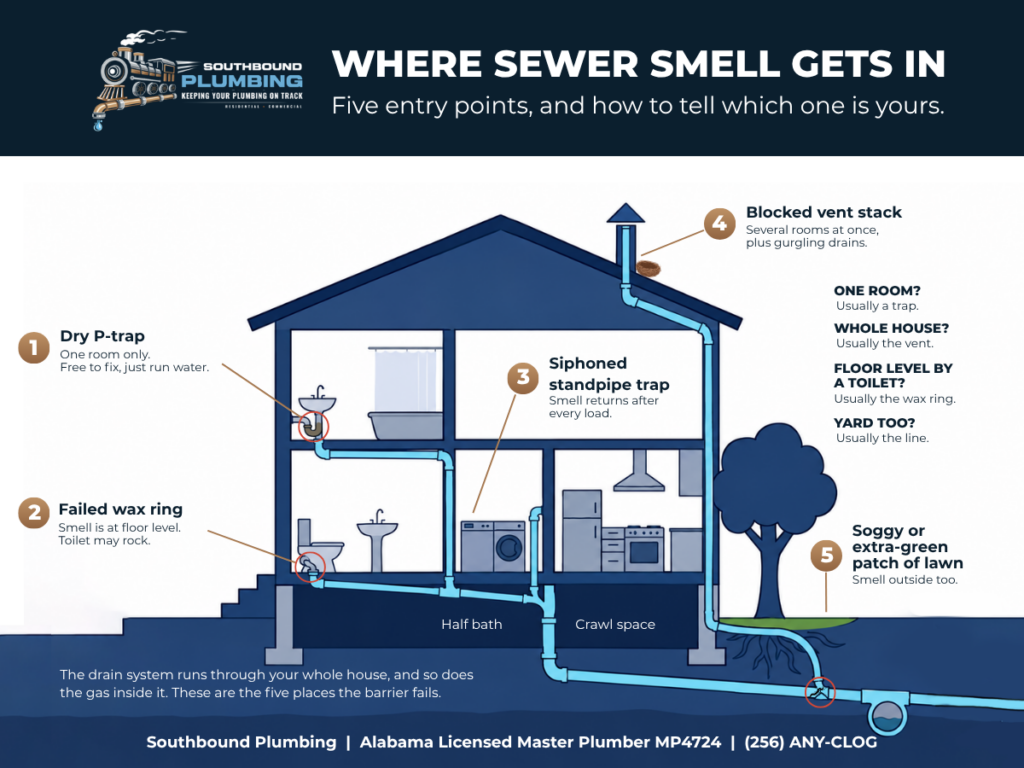
Look under any sink and you’ll see the drain pipe make a U shape before it heads into the wall. That U is a P-trap, and it holds a small amount of standing water at all times. That water is the barrier. Gas coming up the line hits it and stops.
Water evaporates, though, and a fixture nobody uses will eventually run its trap dry. Then the barrier is gone and the line is open to your house. It’s the single most common cause of a sewer smell, it’s more common in summer when the air conditioning is pulling humidity out of the house all day, and it’s why the fix is simply running water.
This is also the reason a lake house at Guntersville or Buck Island greets you with a sewer smell after it’s sat empty a few weeks. Nothing broke. The traps just gave up their water while nobody was there.
Sewer Smell in the Bathroom
Bathrooms have more places for this to go wrong than any other room, so work through them in order of likelihood.
A guest bathroom sink that smells is almost always a dry trap, and the same goes for a shower or tub that only gets used when family visits. Run both for thirty seconds and see what happens over the next day. If the smell is worst right at the sink and running water didn’t help, check the overflow opening, the little hole near the top of the basin, because biofilm builds up inside it and can smell remarkably like sewage without anything actually being wrong with your plumbing.
If the smell is strongest around the base of the toilet, that’s a different problem and it gets its own section below.
Sewer Smell in the Laundry Room or From the Washing Machine
This one gets asked constantly and almost nobody writes about it properly, so here’s what’s actually happening.
Your washing machine drains into a standpipe, the vertical pipe its hose hooks into, and that standpipe has a P-trap at the bottom just like a sink does. Two things go wrong with it. If you only do laundry now and then, the trap dries out. And if the standpipe is too short or the hose is shoved too far down into it, the machine can siphon its own trap empty as it drains, which means the barrier disappears every single time you wash a load.
Run some water down the standpipe and see if the smell clears. If it comes back every time you do laundry, the siphoning version is your answer, and that’s a plumbing correction rather than a maintenance issue.
Worth mentioning separately: a front-load washer that smells musty rather than sulfurous is a different problem entirely, and it’s the door gasket, not your drains.
Sewer Smell in the Basement or Crawl Space
Most homes on this side of Huntsville have a crawl space rather than a basement, which changes this section a bit.
If you do have a basement or a garage with a floor drain, that drain has a trap too, and nobody ever runs water into a floor drain on purpose. Pour a couple of cups down it a few times a year and the problem never starts. In a crawl space, the smell more often points to something structural: a cracked drain line, a failed joint, or a section of pipe that’s separated. Older Huntsville homes with cast iron waste lines are the usual candidates here, because cast iron corrodes from the inside and the joints let go eventually.
A crawl space smell that persists after you’ve run every fixture in the house is worth having somebody look at, because gas getting into a crawl space is getting into your floor system.
Failed Wax Ring Under the Toilet
A toilet sits on a wax ring that seals it to the flange in the floor. When that seal fails, gas comes up around the base, and often a little water does too.
The tells are pretty clear once you know them. The smell is strongest at floor level near the toilet rather than in the bowl. The toilet rocks slightly when you sit down or lean on it. The flooring around the base has darkened, softened, or started to lift. Any of those together with a sewer smell points at the wax ring, and a rocking toilet will keep destroying every new seal until the flange underneath gets addressed properly.
Blocked or Damaged Vent Stack
Every drain system needs air, and it gets it through a vent pipe that runs up through your roof. That vent lets sewer gas out above the house and lets air in behind draining water, which is what keeps your traps from getting siphoned dry.
When it blocks up, and around here that means leaves, a squirrel’s nest, or a bird that got in and couldn’t get out, two things happen at once. Gas that should be leaving through the roof looks for another way out. And drains start pulling their own traps empty because there’s no air behind the water. So you get gurgling from a nearby drain when you flush, slow drains everywhere at once rather than in one fixture, and a smell that shows up in several rooms instead of one.
That combination, several rooms and gurgling drains, is the signature. One room is usually a trap. The whole house is usually the vent.
When the Smell Means a Broken Sewer Line
This is the least common cause and the most expensive one, so it’s worth knowing what separates it from everything else.
A broken or collapsed line usually announces itself outside as much as inside. You get a patch of lawn that stays soggy or unusually green when it hasn’t rained, a smell in the yard near where the line runs, slow drains throughout the house that don’t respond to anything, or backups that keep returning after being cleared. Our red clay soil shifts with wet and dry cycles, and tree roots find any joint that’s already weak, so this does happen here.
If that’s what you’re seeing, it’s a sewer line inspection and drain cleaning call rather than anything to chase around the house with a bucket of water.
Is Sewer Smell Dangerous?
Here’s the honest answer, without softening it or overselling it.
Hydrogen sulfide is genuinely hazardous at high concentrations, the kind found in confined industrial spaces, not typically the kind that drifts out of a guest bathroom. At the levels most households encounter, it’s a nuisance, and the real significance is that it’s telling you something in your plumbing has failed. Headaches, nausea, and eye or throat irritation can show up with prolonged exposure, so it isn’t nothing.
What does warrant a same-day call: a strong odor that won’t clear, a smell that keeps returning after you’ve run every fixture, anyone in the house feeling unwell, or a smell in a closed-up space like a crawl space or a basement. Something that comes and goes faintly in one bathroom is a dry trap. Something strong and persistent is a failure that needs finding.
How to Get Rid of Sewer Smell in Your House
Start with the free version, because it works more often than not. Run water in every fixture in the house, including the ones you forget exist, and pour water into every floor drain you have. Give it a day. Most sewer smells end right here.
If that doesn’t do it, the next step is narrowing down where. One room means look at that room’s fixtures and traps. Several rooms at once, especially with gurgling, means the vent. Strongest at floor level by a toilet means the wax ring. Coming from a crawl space or showing up in the yard means a line problem.
What not to do: pouring bleach down the drain doesn’t fix any of these, and it can make things worse by attacking older pipe. Air fresheners just move the smell around. And a drain that keeps smelling after you’ve run water in it is telling you something real, so it’s worth chasing rather than covering up.
We find and fix all of it. Dry traps that keep drying for a reason, failed wax rings and the flange repairs that go with them, blocked vent stacks, cracked drain lines, and sewer line problems. That work runs through our drain cleaning and sewer service and our plumbing repair and installation work, and a licensed Alabama master plumber performs or directly supervises every job. You’ll have a flat-rate quote in writing before anything starts, and the estimate is free.
If the smell is strong and it isn’t clearing, don’t sit with it over a weekend. Our emergency plumbing service answers around the clock, and homeowners in Jones Valley and the older neighborhoods nearby usually see us fast, since we’re based right here on the east side.
Still Smelling It?
If you’ve run every drain in the house and it’s still there, we’ll come find it. A licensed Alabama master plumber traces the source, tells you plainly what failed, and puts the price in writing before any work begins.
Call (256) 269-2564 or request a free estimate online.
Same-day service, seven days a week.
Frequently Asked Questions
What does sewer gas smell like?
Rotten eggs, mostly. That’s hydrogen sulfide, and people also describe it as sulfurous, sour, or swampy. It typically comes and goes rather than sitting at a steady level, and it’s often strongest first thing in the morning or after the house has been closed up. If what you’re smelling is more musty or earthy than sulfurous, that’s usually mildew rather than sewer gas.
Why does my bathroom sink smell like sewer?
Usually a dry P-trap, which is the U-shaped bend under the sink that holds water and blocks gas from coming back up. In a bathroom that doesn’t get used often, that water evaporates and the barrier disappears. Run the faucet for thirty seconds and see whether it clears over the next day. If it doesn’t, check the overflow opening near the top of the basin, since biofilm builds up in there and smells a lot like sewage.
Why does my washer smell like sewer?
Your washing machine drains into a standpipe with a P-trap at the bottom, and that trap either dried out because you don’t do laundry often, or the machine is siphoning it empty every time it drains. The siphoning version happens when the standpipe is too short or the drain hose is pushed too far down into it. If the smell comes back after every load, that’s the one you have, and it needs correcting rather than just refilling.
Is sewer gas dangerous to breathe?
At the concentrations most homes see, it’s a nuisance rather than a serious hazard, though prolonged exposure can bring on headaches, nausea, and eye or throat irritation. Hydrogen sulfide is genuinely dangerous at high concentrations, but those are industrial-level, not what usually drifts out of a spare bathroom. The more useful point is that the smell means something in your plumbing has failed. A strong odor that won’t clear, or one in a closed-up space like a crawl space, is worth a same-day call.
Will pouring water down the drain fix it?
Often, yes, and it’s always the first thing to try because it’s free. Running water refills a dry P-trap and restores the barrier that was keeping gas out. Do it in every fixture, including the ones you never use, and pour a couple of cups into any floor drains. If the smell clears and stays gone, you’re done. If it comes back within a few days, the trap is being emptied by something else, usually a venting problem.
Who do I call for a sewer gas smell?
A licensed plumber, once you’ve run every fixture and the smell is still there. Tracing an odor properly means checking traps, venting, the wax rings under your toilets, and the drain lines themselves, and it’s the kind of thing that goes faster with somebody who knows the order to check them in. We’re a locally owned plumbing company based in Hampton Cove, and every job is performed or directly supervised by Alabama master plumber MP4724.