Key Takeaways: Tankless vs Tank Water Heater for Alabama Homes
- Huntsville Utilities water drawn from the Tennessee River system carries moderate mineral content — tankless units in this area require annual descaling to stay efficient.
- Tankless units are ideal for newer construction, larger families with staggered hot water demand, and homeowners planning to stay 7+ years.
- Tank water heaters are the better short-term value for homes with budget constraints or when a fast replacement is needed.
- Both types are available in gas and electric models – gas typically delivers faster recovery and lower operating costs in North Alabama.
If your water heater is limping toward the end of its lifespan, you’re likely facing one of the biggest decisions in home plumbing: do you replace it with the same kind of tank unit you’ve always had, or do you upgrade to a tankless system? For homeowners in Huntsville, Madison, and the surrounding communities, the answer depends on your home’s age, your household size, and how long you plan to stay put.
This guide gives you the honest breakdown (costs, efficiency numbers, and real-world performance for Alabama conditions), so you can make a confident decision before you call a plumber.
Direct Answer: Which Is Better, Tankless or Tank?
For most Alabama homeowners planning to stay in their home for 7 or more years, a tankless water heater delivers better long-term value. It costs more upfront but saves 24-34% on water heating energy costs annually (U.S. Department of Energy). For households replacing a failed unit on a budget or living in older homes with existing tank infrastructure, a traditional tank water heater remains a practical and cost-effective choice.
How Each System Works
Traditional Tank Water Heaters
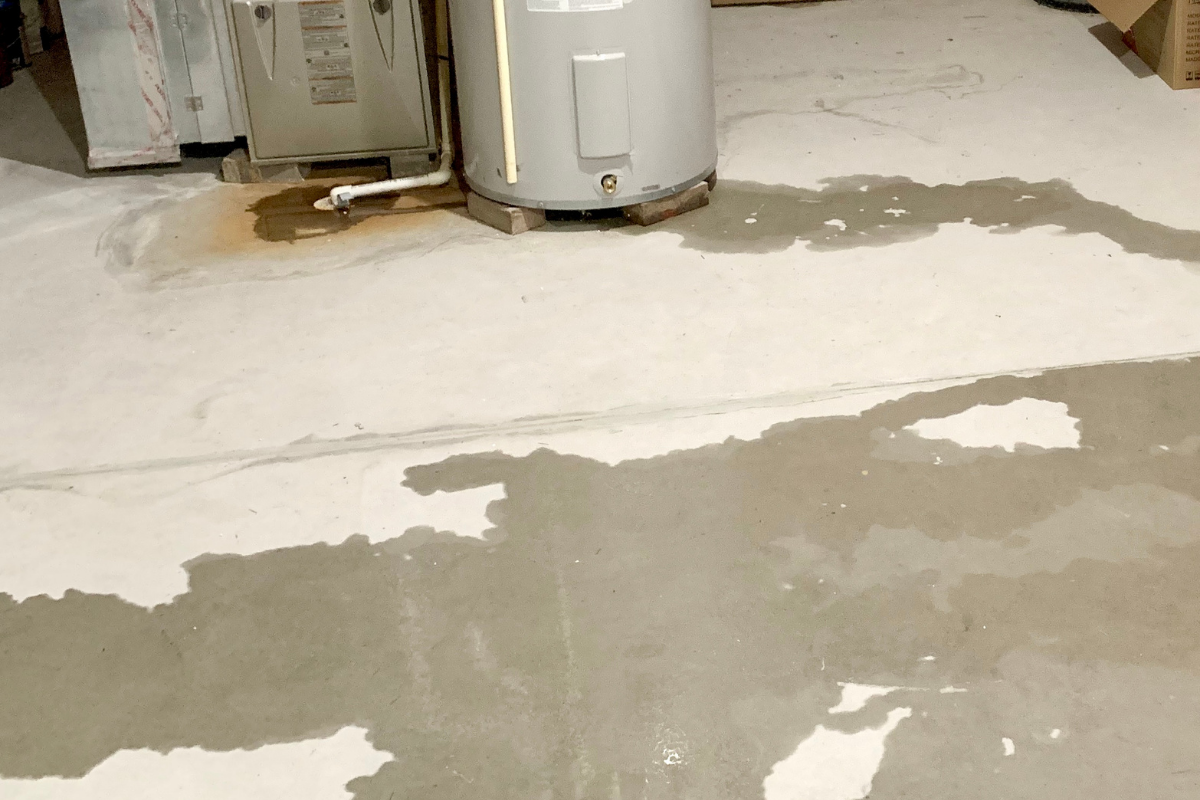
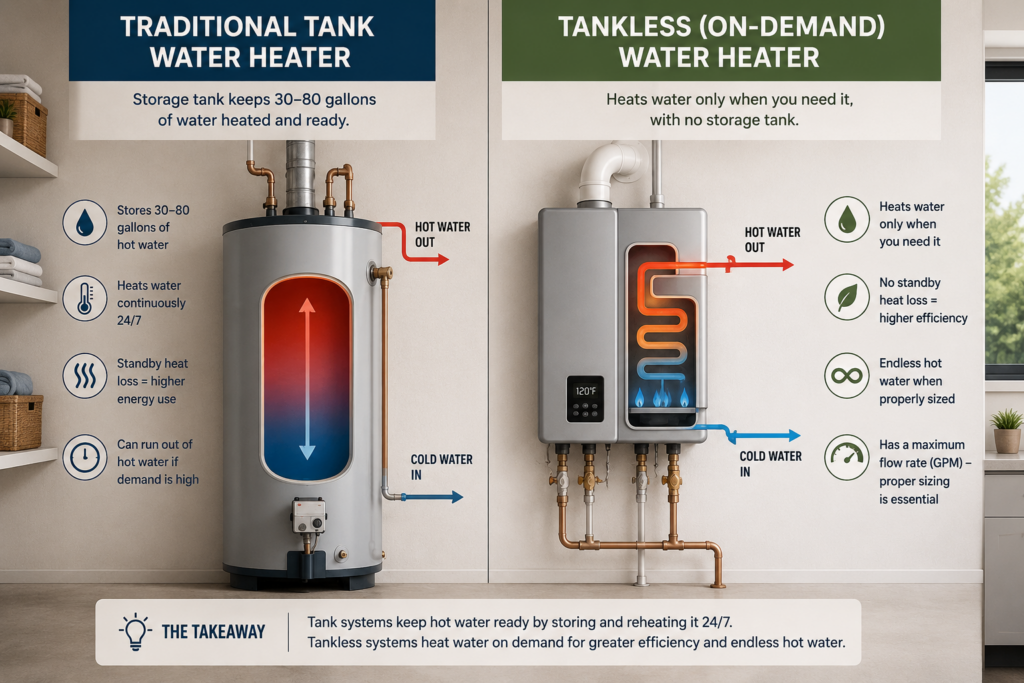
A storage tank water heater keeps 30-80 gallons of water heated and ready at all times. When you turn on the hot tap, heated water flows out and cold water refills the bottom of the tank. Your unit then reheats that water, whether you need it or not.
This continuous heating cycle is called standby heat loss, and it’s the main reason tank water heaters cost more to operate over time. Even a well-insulated tank loses heat to the surrounding air 24 hours a day.
Tankless (On-Demand) Water Heaters
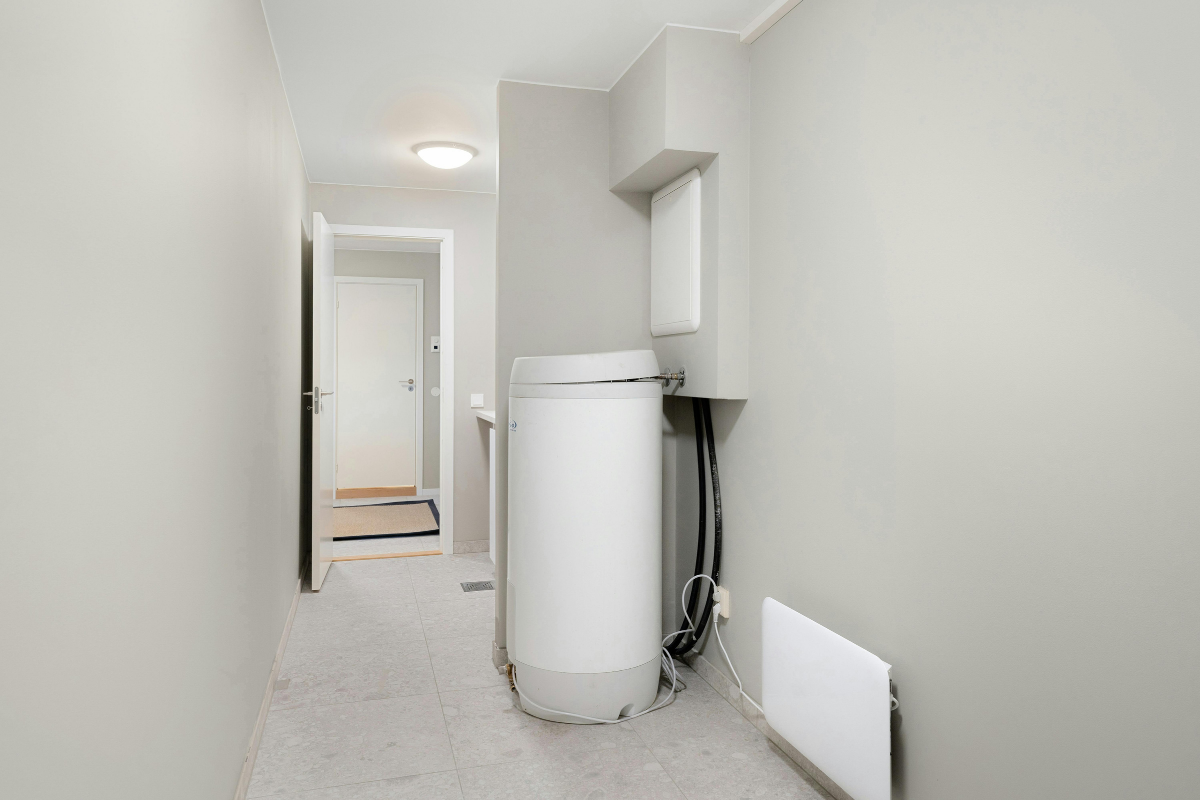
A tankless water heater heats water only when you open a hot tap. Cold water passes through a heat exchanger (powered by gas burners or electric heating elements) and delivers hot water almost instantly. There’s no storage tank, no standby heat loss, and no running out of hot water mid-shower if the unit is properly sized.
The tradeoff: tankless units have a maximum flow rate, measured in gallons per minute (GPM). Undersizing a unit for a large household is one of the most common installation mistakes Southbound Plumbing’s licensed plumbers see in the Huntsville area.
Cost Comparison: Long-Term Operating Costs
The U.S. Department of Energy estimates that tankless water heaters are 24-34% more energy efficient than storage tank models for homes that use 41 gallons or less of hot water daily. For households using more, the savings range from 8-14%.
At current Alabama Power and natural gas rates in the Huntsville market, most households save $100-$200 per year with a tankless unit. Over a 15-20 year lifespan, that adds up, but it takes most homeowners 5-10 years to break even on the higher upfront cost.
Bottom line on cost: Tankless wins long-term. Tank wins short-term.
Alabama-Specific Considerations
Water Quality and Mineral Buildup
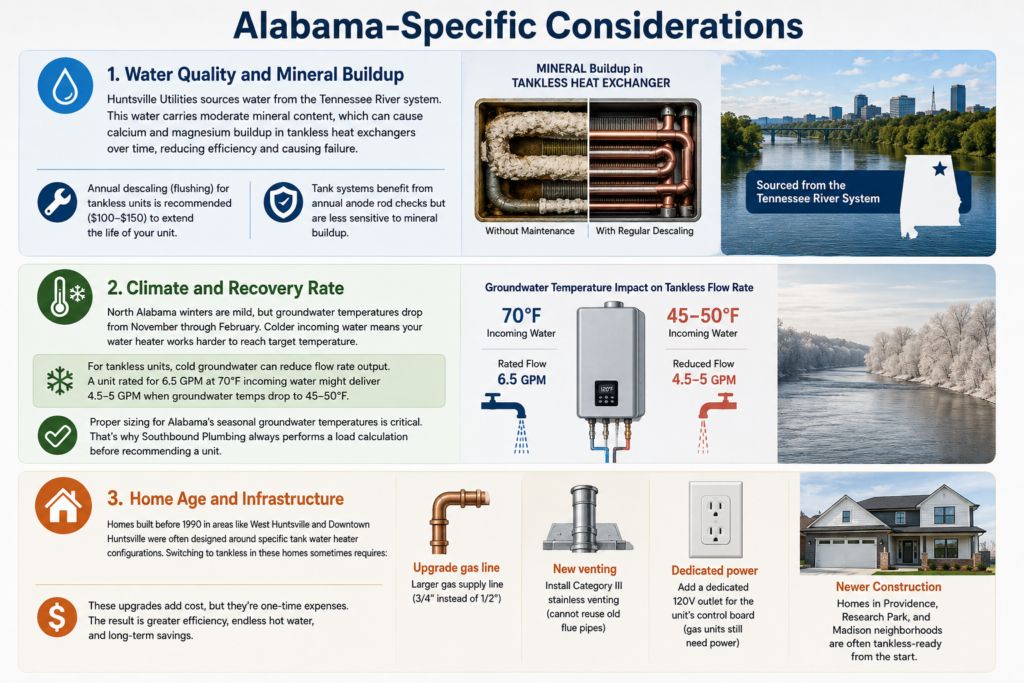
Huntsville Utilities sources water from the Tennessee River system. This water carries moderate mineral content, harder than many people assume for a Southern city. In tankless systems, calcium and magnesium deposits build up inside the heat exchanger over time, reducing efficiency and eventually causing failure.
Southbound Plumbing recommends annual descaling (flushing) for tankless units in the Huntsville area. This service typically costs $100-$150 and extends the life of your unit significantly. Factor this into your long-term cost comparison. It’s a step tank water heater owners don’t need to take.
Traditional tank water heaters also benefit from annual anode rod checks, but they’re less sensitive to mineral buildup than tankless units.
Climate and Recovery Rate
North Alabama winters are mild by national standards, but groundwater temperatures drop noticeably from November through February. Colder incoming water means your water heater, whether tank or tankless, works harder to reach target temperature.
For tankless units, cold groundwater can reduce flow rate output in winter. A unit rated for 6.5 GPM at 70°F incoming water might deliver 4.5-5 GPM when groundwater temps drop to 45-50°F. Proper sizing for Alabama’s seasonal groundwater temperatures is critical. This is why Southbound Plumbing always performs a load calculation before recommending a unit.
Home Age and Infrastructure
Homes built before 1990 in areas like West Huntsville and Downtown Huntsville were often designed around specific tank water heater configurations. Switching to tankless in these homes sometimes requires:
- Upgrading to a larger gas supply line (3/4″ instead of 1/2″)
- Installing new Category III stainless venting instead of reusing existing flue pipes
- Adding a dedicated 120V outlet for the unit’s control board (gas tankless units still need power)
These upgrades add cost, but they’re one-time expenses. Newer construction in Providence, Research Park, and Madison neighborhoods is often tankless-ready from the start.
Lifespan and Maintenance
Tank water heaters typically last 8-12 years. With annual anode rod replacement and the occasional flush, you might squeeze 15 years out of a quality unit.
Tankless water heaters are rated for 20+ years when properly maintained. Many manufacturers––including Navien, Rinnai, and Noritz––offer 15-year heat exchanger warranties on residential models. That longevity is a major factor in the long-term value calculation.
Maintenance requirements at a glance:
- Tank: Annual anode rod inspection, flush sediment every 1-2 years
- Tankless: Annual descaling flush, filter screen cleaning, occasional venting inspection
Who Should Choose Tankless?
A tankless water heater makes the most sense when:
- You plan to stay in your home for 7+ years
- Your household has staggered hot water demand (people showering at different times, not all at once)
- You want to reduce your energy bill long-term
- You’re building new or your home already has the gas and venting infrastructure for it
- You want the space savings of a wall-mounted unit
Who Should Stick With a Tank?
A traditional tank water heater is the better call when:
- You need a fast, affordable replacement (tank units can be installed same-day in most Huntsville-area homes)
- Your home would require significant infrastructure upgrades for tankless
- You plan to sell the home within the next 5 years
- Your household has simultaneous high hot water demand that might exceed a tankless unit’s flow rate
- Budget is the primary concern right now
FAQs
Is a tankless water heater worth it in Alabama?
For most Alabama homeowners planning to stay in their home 7 or more years, yes. Tankless units cut water heating costs by 24–34% annually according to the U.S. Department of Energy. The upfront cost is higher, but the energy savings and 20-plus-year lifespan make it a strong long-term investment in Alabama’s climate.
How much does it cost to install a tankless water heater in Huntsville, Alabama?
Total installed cost for a tankless water heater in the Huntsville area typically runs $1,000 to $3,500 or more, depending on the unit, fuel type, and whether your home needs gas line or venting upgrades. Traditional tank replacement runs $700 to $1,500 installed. Get a quote that includes any infrastructure work before comparing prices.
Do tankless water heaters work well with Huntsville’s water?
They work well but require annual maintenance. Huntsville Utilities draws from the Tennessee River system, which has moderate mineral content. Calcium deposits can build up inside the heat exchanger and reduce efficiency over time. Southbound Plumbing recommends annual descaling flushes for all tankless units in the Huntsville area to keep them running at full efficiency.
What size tankless water heater do I need for a 3-bedroom home in Alabama?
A 3-bedroom home in Alabama typically needs a tankless unit with a flow rate of 6 to 8 GPM to handle simultaneous demand. Factor in winter groundwater temperatures. Incoming water can drop to 45 to 50°F in North Alabama, which reduces output. A licensed plumber should perform a load calculation based on your home’s fixture count and usage patterns before recommending a unit size.
Can I replace my tank water heater with a tankless unit myself?
Not recommended, and in Alabama, not legal without a permit. Tankless installation often involves gas line work, new venting, and electrical connections that require licensed plumber permits under Alabama State Plumbing Code. Improper installation can void manufacturer warranties, fail home inspections, and create safety hazards. Always use a licensed plumber for water heater replacement.
How long does a tankless water heater last compared to a tank unit?
Tankless water heaters are rated to last 20 or more years with proper annual maintenance. Traditional tank water heaters typically last 8 to 12 years. The longer lifespan is one of the strongest arguments for choosing tankless — you’re likely to replace a tank unit twice in the time a well-maintained tankless unit keeps running.
What’s the best water heater brand for Alabama homes?
Rinnai, Navien, and Noritz are consistently strong performers in Alabama’s climate for tankless units. Bradford White and Rheem are reliable choices for tank water heaters. Brand matters less than proper sizing and installation. A quality unit installed wrong will underperform every time, which is why Southbound Plumbing performs a full assessment before recommending any unit.
Ready to Decide? Talk to a Huntsville Plumber First
Choosing between a tankless and tank water heater is a long-term financial decision, not just a plumbing call. The right answer depends on your home’s age, gas infrastructure, household size, and how long you plan to stay. That’s exactly the conversation Southbound Plumbing’s licensed plumbers have with homeowners across Huntsville, Madison, Meridianville, Harvest, and Owens Cross Roads every week.
Southbound Plumbing offers honest, no-pressure water heater assessments, serving the areas of Huntsville, Madison, Meridianville, Harvest, and Owens Cross Roads, AL. We’ll tell you what your home actually needs, not just what’s most profitable to install.
Call us today or contact us online – emergency plumbing appointments available for water heater replacement throughout the Huntsville area.